Unifying the Post-Purchase Journey
Harmonizing 5 distinct fulfillment channels into a single, transparent tracking experience.
Company
Home Depot
Timeline
2021
—
2022
Role
UX Strategist
Focus
Omnichannel Strategy, System Synthesis, Mobile Optimization
Impact
Reduced "Where is my order?" (WISMO) anxiety for 7.3M+ annual page visitors
Project overview
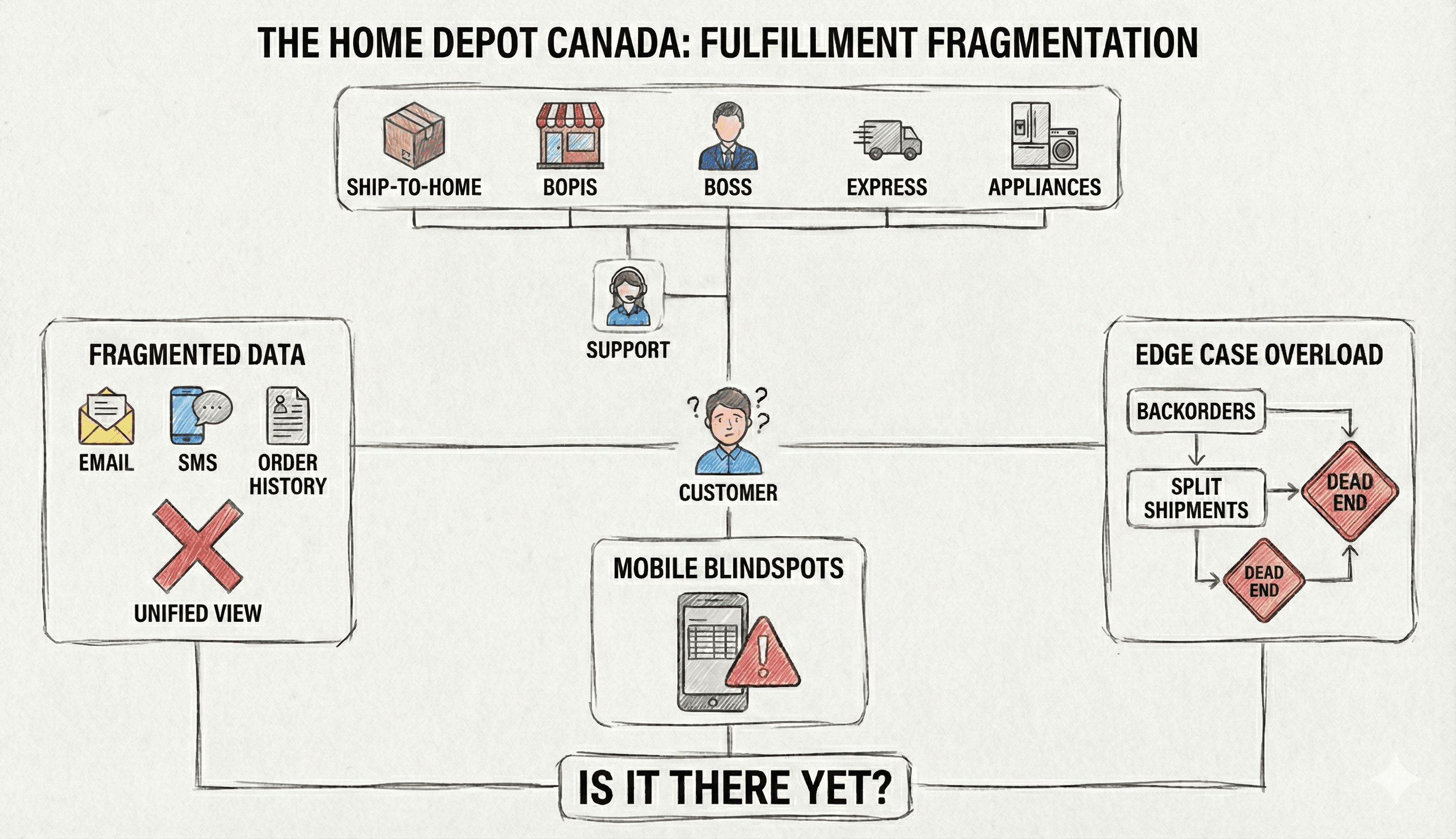
The Home Depot offers five distinct fulfillment models, ranging from Ship-to-Home and Buy Online, Pick Up In Store (BOPIS) to complex vendor drop-ships (BOSS).
While efficient for logistics, this created chaos for the customer. Legacy systems exposed raw backend statuses, meaning a single order with mixed items could result in three different "tracking" experiences. This fragmentation eroded trust and drove high contact-centre volume as customers struggled to answer one simple question: "Is it here yet?"
The core friction:
Fragmented Data: Email, SMS, and Order History often showed conflicting ETAs
Mobile Blindspots: 60% of tracking inquiries were on mobile, yet the legacy table-based design was unreadable on small screens
Edge Case Overload: Complex scenarios (i.e. backorders, split shipments) had no standardized UI, leading to dead ends
Critical Decisions
During the design phase, a key trade-off emerged: Data Availability vs. User Clarity.
Engineering proposed showing every available carrier scan (e.g., "Arrived at sort facility") but user testing revealed that "too much information" increased anxiety when scans stalled, so I pushed for a simpler model.
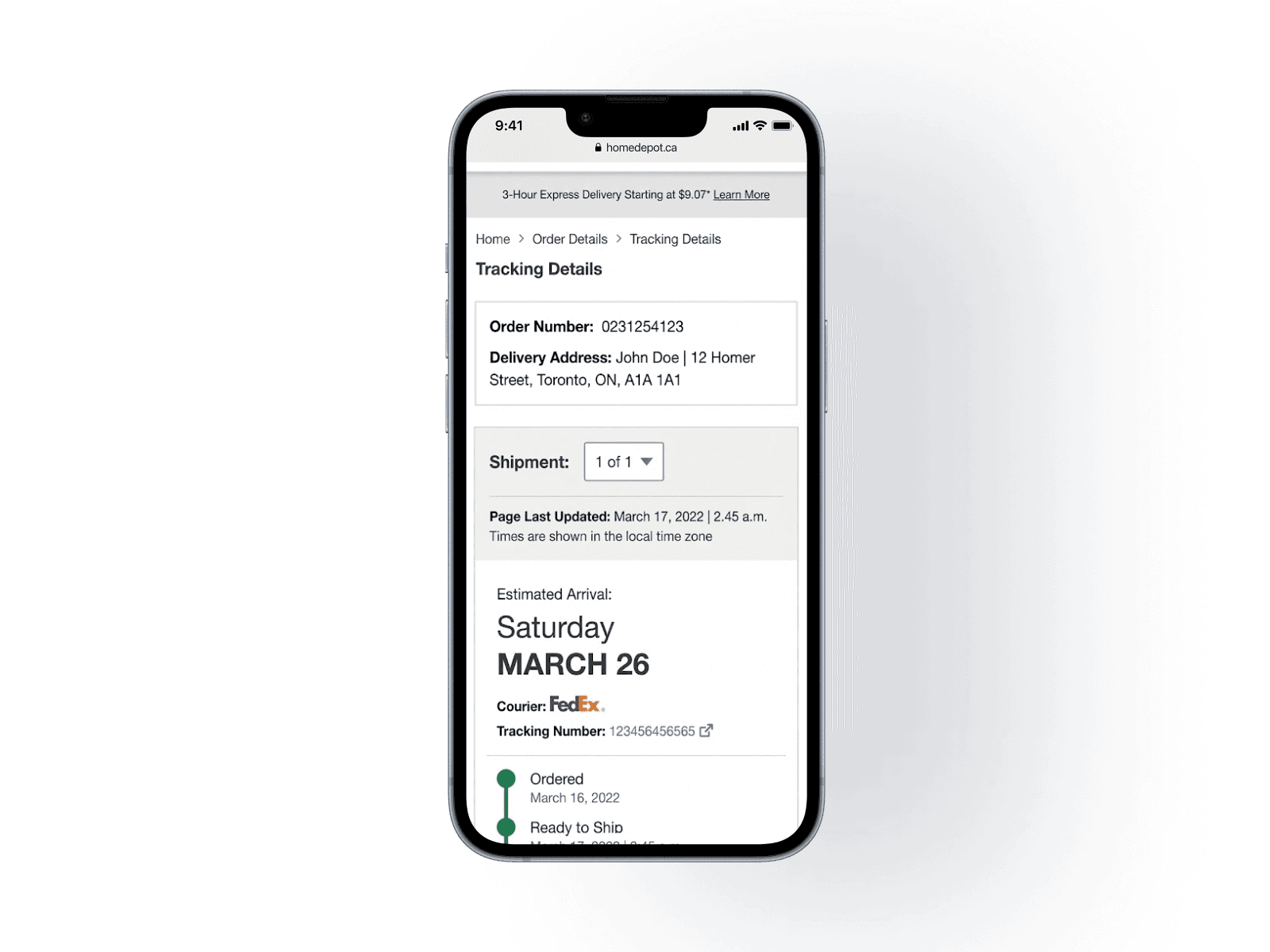
The Decision: I grouped granular carrier events under a simplified "In Transit" parent status. I provided a deep-link to the carrier site for power users but kept the primary UI focused on the macro-milestone. This reduced cognitive load and focused the user on the outcome (delivery date) rather than the process.
The Solution
I led the solution: a mobile-first tracking architecture designed for the anxious user, developed with the wider team.
The "at-a-glance" Tracker: A visual progress bar that works instantly on mobile, answering the status question in <3 seconds
Proactive Clarity: Smart messaging for edge cases (e.g., "One item is delayed, but the rest are on time") prevents panic before it starts
Unified Visual Language: Whether a user buys a drill (Store Pickup) or a fridge (Delivery), the status language remains consistent
Results
By shifting from a logistics-driven view to a customer-centric model, I led the team in re-imagining the bottom of the funnel.
Scaled Trust: Successfully harmonized the post-purchase experience for 7.3M+ annual visits
Operational Efficiency: Created a single scalable UI framework that product teams can use for future fulfillment channels without custom "patches"
Mobile Parity: Delivered a responsive experience that finally served the 60% majority of mobile users with first-class functionality
Unifying the Post-Purchase Journey
Harmonizing 5 distinct fulfillment channels into a single, transparent tracking experience.
Company
Home Depot
Timeline
2021
—
2022
Role
UX Strategist
Focus
Omnichannel Strategy, System Synthesis, Mobile Optimization
Impact
Reduced "Where is my order?" (WISMO) anxiety for 7.3M+ annual page visitors
Project overview
The Home Depot offers five distinct fulfillment models, ranging from Ship-to-Home and Buy Online, Pick Up In Store (BOPIS) to complex vendor drop-ships (BOSS).
While efficient for logistics, this created chaos for the customer. Legacy systems exposed raw backend statuses, meaning a single order with mixed items could result in three different "tracking" experiences. This fragmentation eroded trust and drove high contact-centre volume as customers struggled to answer one simple question: "Is it here yet?"
The core friction:
Fragmented Data: Email, SMS, and Order History often showed conflicting ETAs
Mobile Blindspots: 60% of tracking inquiries were on mobile, yet the legacy table-based design was unreadable on small screens
Edge Case Overload: Complex scenarios (i.e. backorders, split shipments) had no standardized UI, leading to dead ends
Critical Decisions
During the design phase, a key trade-off emerged: Data Availability vs. User Clarity.
Engineering proposed showing every available carrier scan (e.g., "Arrived at sort facility") but user testing revealed that "too much information" increased anxiety when scans stalled, so I pushed for a simpler model.
The Decision: I grouped granular carrier events under a simplified "In Transit" parent status. I provided a deep-link to the carrier site for power users but kept the primary UI focused on the macro-milestone. This reduced cognitive load and focused the user on the outcome (delivery date) rather than the process.
The Solution
I led the solution: a mobile-first tracking architecture designed for the anxious user, developed with the wider team.
The "at-a-glance" Tracker: A visual progress bar that works instantly on mobile, answering the status question in <3 seconds
Proactive Clarity: Smart messaging for edge cases (e.g., "One item is delayed, but the rest are on time") prevents panic before it starts
Unified Visual Language: Whether a user buys a drill (Store Pickup) or a fridge (Delivery), the status language remains consistent
Results
By shifting from a logistics-driven view to a customer-centric model, I led the team in re-imagining the bottom of the funnel.
Scaled Trust: Successfully harmonized the post-purchase experience for 7.3M+ annual visits
Operational Efficiency: Created a single scalable UI framework that product teams can use for future fulfillment channels without custom "patches"
Mobile Parity: Delivered a responsive experience that finally served the 60% majority of mobile users with first-class functionality